
Three Reasons to Become a Free Gardener


Some people join an order for its history.
Others are drawn to its symbols.
Some simply want fellowship.
Free Gardening offers all three. But it also asks something of you.
It asks you to grow.
It asks you to serve.
It asks you to leave good soil for those who come after you.
Here are three reasons to become a Free Gardener.
1. You Learn to Cultivate Yourself

A garden does not improve through neglect.
Neither does a person.
Good character takes work. It takes patience. It also takes honest self-examination.
In The Gate and the Garden, I wrote:
“The central lesson of the Free Gardeners is cultivation. Human character, like ground, does not flourish through neglect.” (p. 62)
Free Gardening teaches us to look inward.
Some habits need to be watered.
Some need to be removed.
Some parts of our lives need patience. Others need the careful cut of the pruning knife.
This is not about pretending to be perfect.
It is about becoming more useful. More disciplined. More dependable.
A Free Gardener understands that real growth is slow. It happens through repeated choices.
You show up.
You keep your word.
You learn from correction.
You do the work, even when no one is watching.
Over time, those small actions bear fruit.
2. You Find Brotherhood with a Purpose

Many groups speak about brotherhood.
The Free Gardener tradition gives brotherhood work to do.
As I wrote:
“Brotherhood becomes real through mutual aid.” (p. 63)
That is a simple statement. But it carries weight.
Brotherhood is not only a title. It is not a handshake, an apron, or a place at the table.
It means being present when someone is struggling.
It means visiting the sick.
It means helping a family after a death.
It means offering guidance without trying to control another person.
The old Free Gardener lodges created funds for sickness, funerals, widows, orphans, and hardship. Members gave while they were able. They received help when they were in need.
The world has changed. The duty has not.
People still face grief. They still lose jobs. They still become ill. They still feel forgotten.
A strong lodge notices.
A true brother remembers.
That kind of fellowship is rare. It cannot be built in one evening. It grows through trust, service, and shared labor.
3. You Leave Something Living Behind
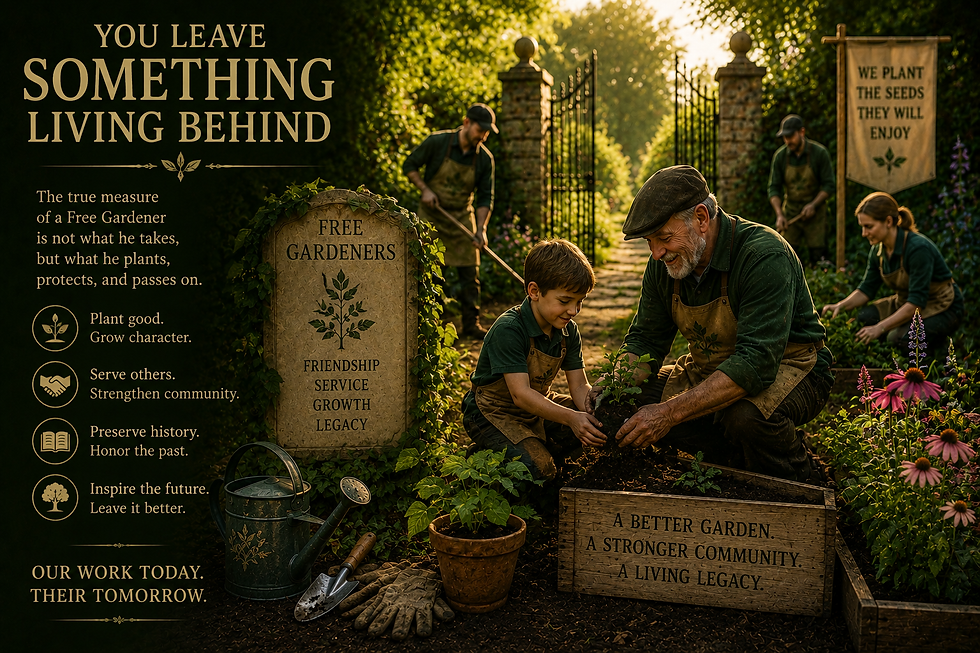
Free Gardening is not about escaping into the past.
It is about carrying the best of the past into the future.
History matters. Regalia matters. Ceremony matters.
But they must lead to useful work.
In the book, I put it this way:
“Regalia can announce identity. Service verifies it.” (p. 57)
A Free Gardener should leave evidence of his labor.
That may be a community garden.
It may be food grown for families in need.
It may be a restored cemetery, a planted tree, or a young person taught how to care for the soil.
It may also be a well-kept archive. Clear minutes. Honest accounts. Preserved photographs. A history that the next generation will not have to guess at.
The goal is not to look important.
The goal is to be useful.
As I wrote near the end of The Gate and the Garden:
“The garden does not argue for itself. It bears fruit.” (p. 64)
That may be the best measure of a Free Gardener.
What has he planted?
Whom has he helped?
What has he preserved?
Is the ground better because he was there?
Enter the Garden

Become a Free Gardener to grow in character.
Become one to find a brotherhood that serves.
Become one to leave something living behind.
Come for the history.
Learn the symbols.
Wear the apron with respect.
Then pick up the tools.
The future of Free Gardening will not be secured by admiration alone.
It will be secured by work.
Continue the Journey

If you’d like to learn more about the history, symbolism, and revival of the Free Gardeners, explore my book:
The gate is open.
The journey is yours.


Comments