
The Quiet Threat Most Security Guards Never Talk About


The biggest mistake a security guard makes during a shift is rarely caused by a lack of training.
It is usually caused by fatigue.
Not the kind that makes you fall asleep.
The kind that makes you stop noticing.
I’ve seen guards miss things during the twelfth hour of a shift that they would have caught immediately during the first thirty minutes.
Not because they were bad guards.
Because they were mentally drained.
The radio never stops.
The phone rings.
Visitors arrive.
Contractors check in.
Employees ask questions.
Deliveries show up.
Someone needs help finding a door.
Someone wants an exception.
Someone wants you to hurry.
By the end of a long shift, your brain starts looking for shortcuts.
That is when mistakes happen.
Not dramatic mistakes.
Small ones.
The kind that seem harmless at the time.
You skip a verification.
You assume someone belongs there.
You glance at a camera instead of really watching it.
You tell yourself, “It’s probably fine.”
Those four words have started more security problems than most guards realize.
The Danger of Running on Autopilot

Most people imagine security failures happen because someone forced a door or climbed a fence.
Sometimes that happens.
More often, a problem walks through the front door.
The guard is distracted.
The guard is rushed.
The guard is mentally tired.
The person looks normal.
The story sounds reasonable.
The verification gets skipped.
The incident begins.
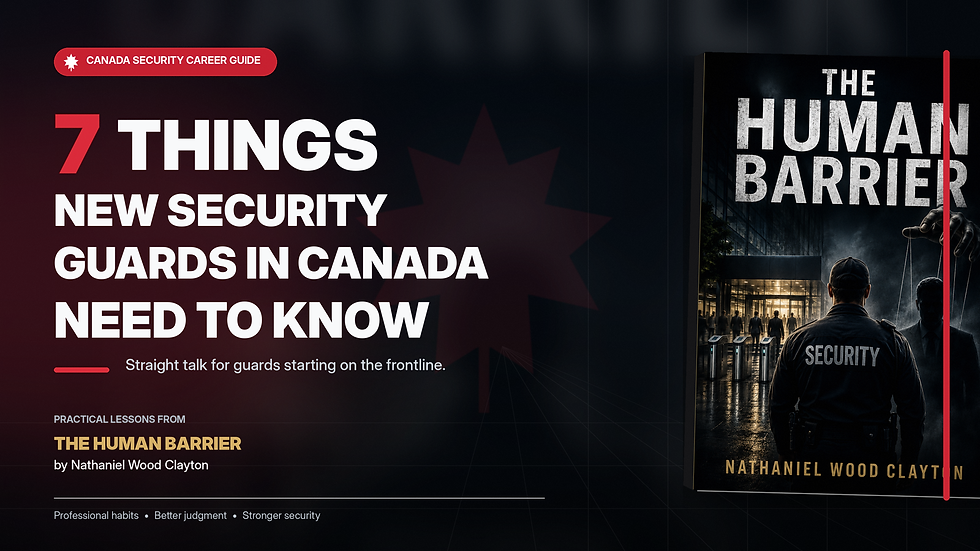
As I wrote in The Human Barrier:
“An organization’s defensive posture is only as strong as its most impressionable human interaction.”
That interaction might happen at a gate.
A front desk.
A loading dock.
An employee entrance.
One moment of reduced attention can undo every security measure behind you.
Signs You May Be Becoming Complacent

Complacency rarely arrives all at once.
It creeps in.
Watch for these warning signs:
You stop challenging unfamiliar people.
You rely on assumptions instead of verification.
You rush reports because “nothing happened.”
You stop conducting thorough patrols.
You spend more time looking at your phone than your surroundings.
You stop noticing small changes in your area.
These habits develop slowly.
That is what makes them dangerous.
How Experienced Guards Stay Sharp

The best guards understand that awareness is a skill.
Like any skill, it fades if you stop using it.
One simple exercise is to force yourself to notice something new every patrol.
A door that is normally closed.
A vehicle that was not there before.
A light that is out.
A piece of equipment that has moved.
Small observations keep your mind engaged.
Good note-taking helps too.
Writing observations forces you to pay attention.
It keeps your brain actively processing what is happening around you instead of drifting into routine.
Most importantly, slow down when someone asks you to rush.
Pressure is often where mistakes begin.
A professional guard understands that taking an extra thirty seconds to verify something is usually faster than spending three hours writing an incident report afterward.
The Professional Difference

Anyone can stay alert during an emergency.
The real test comes during a quiet shift.
A rainy Tuesday.
Three in the morning.
Nothing happening.
Nobody watching.
That is when professionalism matters most.
Because security is not about reacting when something goes wrong.
It is about preventing problems before they happen.
Most breaches do not begin with force.
They begin with inattention.
The guard who stays focused during the quiet hours is often the one who prevents the incident that never makes the news.
And that is what professional security is really about.
Conclusion: Professionalism When Nobody Is Watching

The difference between an average guard and a professional guard is not usually found during an emergency.
It is found during the quiet hours.
When the shift is long.
When the building is calm.
When the cameras all look the same.
When nobody seems to need anything.
That is when complacency begins to creep in.
The guards who remain sharp are the guards who understand that security is not just about responding to incidents. It is about preventing them.
They continue to observe.
They continue to verify.
They continue to think.
Even when nothing appears to be happening.
That mindset is at the heart of The Human Barrier.
The greatest security vulnerability is rarely a broken lock, a faulty camera, or a failed access control system.
It is the moment a person stops paying attention.
A distracted employee.
A rushed supervisor.
A complacent guard.
A social engineer only needs one moment of inattention.
A professional security officer works to make sure that moment never comes.
If you found this article valuable and want to deepen your understanding of situational awareness, social engineering, manipulation tactics, access control, verification procedures, and the human factors that cause security failures, The Human Barrier explores these subjects in far greater detail.
Because in the end, security is not just about protecting a building.
It is about becoming the barrier that stands between a threat and the people you are entrusted to protect.
Stay alert. Stay professional. Stay the Human Barrier.


Comments